Across the world, the way infrastructure is financed is undergoing a quiet but significant shift. Governments that once relied heavily on public budgets and sovereign borrowing are now grappling with tighter fiscal conditions, rising debt burdens, and growing public demand for reliable power, transport, water, and digital services. In many emerging markets, this pressure is forcing a rethink, opening the door for private capital, particularly infrastructure debt, to play a more central role.
Institutional investors such as pension funds, insurers, and sovereign wealth funds are increasingly drawn to infrastructure debt because of its ability to deliver stable, long-term returns backed by real assets. Unlike equity, which can be volatile, infrastructure debt offers predictable cash flows tied to essential services like energy, roads, and connectivity. As global demand for infrastructure rises, driven by urbanisation, digital transformation, and the transition to cleaner energy, the appeal of this asset class continues to grow.
The scale of the opportunity is immense. Estimates suggest that the world will require trillions of dollars in infrastructure investment over the coming decades to meet development and climate goals. Yet public funding alone is no longer sufficient. This gap is particularly evident in Africa, where infrastructure deficits remain wide and development financing has become more constrained due to higher interest rates and reduced external support.
In this context, infrastructure debt funds are emerging as a practical solution. By structuring financing around tangible, revenue-generating assets, these funds help channel long-term capital into projects that might otherwise struggle to secure funding. Blended finance models, where public and private capital are combined with risk mitigation tools, have proven especially effective in attracting investors who would otherwise be cautious about emerging market risks.
Global experience offers clear lessons. First, well-structured deals that distribute risk across different layers of capital can unlock significant investment. Second, strong and predictable regulatory environments are critical; investors need confidence that contracts will be honoured and pricing systems will remain stable. Third, environmental and social considerations are no longer optional: projects aligned with sustainability goals are increasingly favoured by global capital providers.
Nigeria reflects both the opportunity and the challenge. With one of the largest infrastructure gaps in the world and a rapidly growing population, the need for investment spans power, transport, agriculture, and digital connectivity. While government funding remains limited, domestic institutional investors, particularly pension funds, are beginning to play a more active role, allocating capital to instruments such as Sukuk bonds and infrastructure debt funds.
However, constraints persist. Foreign exchange risk continues to deter international investors, especially where project revenues are earned in local currency but debt obligations are denominated in dollars. Policy inconsistency, limited pipelines of bankable projects, and regulatory constraints also slow momentum. Addressing these challenges will be key to unlocking larger flows of capital.
Across Sub-Saharan Africa, similar patterns are emerging. Development finance institutions and multilateral agencies are stepping in with guarantees, credit enhancements, and co-investment structures designed to reduce risk and crowd in private capital. At the same time, there is a growing recognition that local currency financing, supported by domestic capital markets and pension funds, will be essential for long-term sustainability.
The path forward is becoming clearer. Countries that invest in strong project preparation, deepen regulatory credibility, and adopt blended finance approaches are more likely to attract sustained investment. Managing foreign exchange risk and embedding ESG principles will further strengthen investor confidence.
Infrastructure debt is not a silver bullet, but it is increasingly becoming a cornerstone of how emerging markets finance development. For Nigeria and the broader African region, the opportunity lies in building a resilient financing ecosystem, one that combines local and global capital, balances risk effectively, and supports inclusive growth.
If these elements come together, infrastructure debt could play a transformative role in closing the continent’s infrastructure gap and unlocking long-term economic potential.
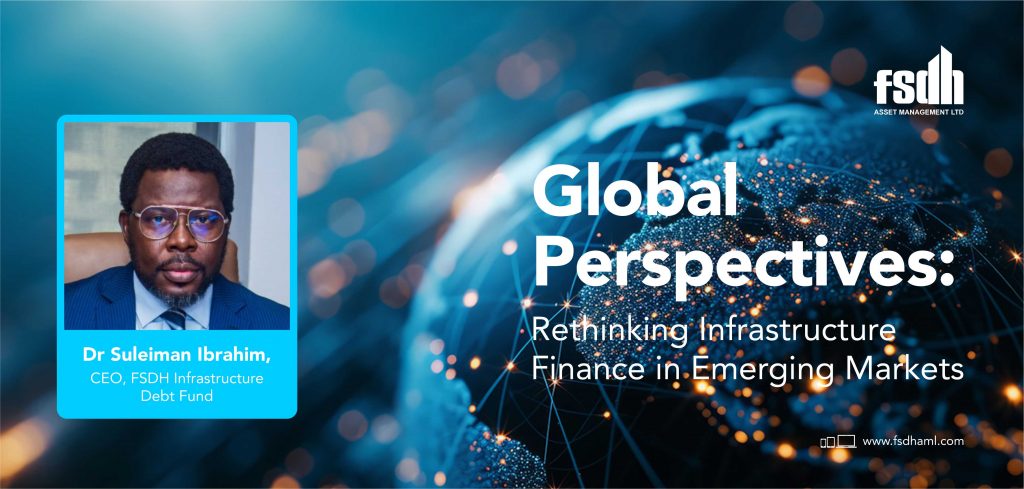
Dr Suleiman Ibrahim, CEO, FSDH Infrastructure Debt Fund
Contact us today at [email protected], 0201 700 8900, or visit www.fsdhaml.com to learn more.